Posted on 11th November by Proofers Editorial Team
AI detection tools are now used by universities, publishers and employers to identify AI-generated content — and many writers are looking for ways to avoid being flagged. This article explains how AI detection works, what the current tools can and cannot do, and the techniques writers use to reduce AI signals in their text.
Whether you are a student concerned about unfair detection, a content creator using AI as a drafting aid, or simply curious about how these tools work, this guide covers everything you need to know.
“How to avoid AI detection in writing” is now one of the most-searched questions among students and content writers. AI detection tools are increasingly sophisticated — and so are the methods people use to get around them. This guide explains what actually works, what doesn’t, and what the smarter approach really is.
What Is AI Detection and How Does It Work?
AI detection tools — including those built into Turnitin and standalone tools like GPTZero — analyse patterns in text to estimate the likelihood that it was generated by an AI model.
They look for characteristics common in AI-generated writing:
Perplexity — how predictable or uniform the word choices are
Burstiness — whether sentence length and structure vary (humans vary more; AI tends to be consistent)
Overly formal or hedged language — common patterns in models like ChatGPT
Specific vocabulary patterns — certain words and phrases are statistically more common in AI output
No detector is 100% accurate. They produce false positives (flagging human writing as AI) and false negatives (missing AI writing). But accuracy is improving — particularly for academic submission platforms like Turnitin. We cover the technical side in more detail here: Can Turnitin detect AI writing?
It’s also worth understanding that AI detection isn’t just a software problem. Lecturers and editors who read a lot develop their own intuition for AI-generated text: a certain smoothness, a lack of genuine opinion, a tendency to hedge rather than assert. Even when detection tools give a low score, human readers may still recognise the patterns.
Does Avoiding AI Detection Actually Work?
Some techniques reduce AI detection scores, some of the time. But “reducing a detection score” is not the same as “making your writing undetectable.” As detection tools improve, circumvention techniques become less reliable.
More importantly, most techniques that reduce AI signals do so by making the text more human — which means rewriting it, adding personal insight, and varying the structure. At that point, you’re essentially writing the content yourself, which raises the question: why use AI in the first place?
There’s also a fundamental asymmetry here. AI detection tool developers have access to vast amounts of both human and AI-generated text, and they retrain their models continuously. The techniques that worked six months ago work less well today. Any approach to “beating” detection is a temporary workaround in an arms race you are unlikely to win long-term.
Techniques Writers Use to Reduce AI Signals
These are the approaches commonly discussed, with an honest assessment of each:
Paraphrasing AI output yourself
Effectiveness: Moderate. Manually rewriting AI-generated text in your own voice can significantly reduce detection scores, especially if you vary sentence length, add personal examples, and change the structural patterns. This is time-consuming but legitimate — at the point of substantial rewriting, the work is increasingly yours.
Using a paraphrasing tool
Effectiveness: Low. Automated paraphrasing tools (like QuillBot set to aggressive rewrite) can reduce AI signals, but they often introduce grammatical errors and produce stilted text. Sophisticated detectors have also adapted to flag heavily paraphrased AI content. Our professional paraphrasing service produces far better results than automated tools.
Adding personal anecdotes and examples
Effectiveness: Good. AI models struggle to include genuine personal experience, specific local context, and original insight. Injecting these into AI-generated text — real examples, your own observations, specific references to your own experience — reduces AI signals and improves the quality of the writing. This is probably the most legitimate technique because it makes the work genuinely more yours.
Varying sentence length and structure deliberately
Effectiveness: Moderate. AI text tends to have uniform sentence length. Deliberately adding short, punchy sentences and mixing in longer, more complex ones can reduce detection. Combined with other changes, it helps. On its own, it’s a cosmetic fix.
Removing typical AI vocabulary
Effectiveness: Low to moderate. Certain words appear disproportionately often in AI output: “delve,” “crucial,” “it’s worth noting,” “in conclusion,” “furthermore,” “robust,” “leverage,” “notably.” Removing these helps marginally, but it’s not sufficient alone and detection tools are increasingly looking at patterns beyond individual words.
Running text through a “humaniser” tool
Effectiveness: Variable and declining. Several tools claim to transform AI text into human-sounding text. Their effectiveness varies widely. Many simply rephrase in ways that introduce new errors. Detection tools have specifically adapted to flag text that has been processed through known humanisers. We discuss this in more detail in our AI detection statistics for 2026.
The Academic Risk You Need to Understand
If you’re a student, there’s a more fundamental issue. Most universities now have policies on AI use that go beyond detection software. Even if you successfully lower your Turnitin AI score, you may still be found out through:
Viva examinations or follow-up questions on your work
Inconsistency between your submitted work and your previous work or in-class writing
Lecturer familiarity with AI writing patterns, which is increasing rapidly
Institutional spot-checks and sampling of submitted work
The consequences of academic misconduct findings are serious. For students who want to use AI as a starting point legitimately, the right approach is to treat AI output as a first draft and rewrite it substantially — then have it reviewed by our AI content editing service.
Beyond the risk of being caught, there’s a more practical consideration: if you can’t explain or expand on what’s in your submitted work, you’re not building the knowledge or skills your qualification is supposed to give you. That matters when you’re in a job or further study that depends on those skills.
What About Content Writers and Marketers?
The context for content writers and marketers is different from students. There is no academic integrity issue. The concern is usually about:
Search engine penalties for AI-generated content (Google’s position has evolved: quality and helpfulness matter more than origin, but thin AI content still performs poorly)
Client requirements to deliver “human” content
Brand voice and authenticity, which AI-generated content often lacks
For content professionals, the most effective approach is using AI as a research and drafting tool, then significantly editing and personalising the output. Our AI content editing service is specifically designed for this workflow: we take AI-drafted content and make it read as polished, authentic human writing. The result typically scores low on AI detection tools because it genuinely has been substantially edited by a human.
A Better Approach: AI Editing Done Properly
The most effective and legitimate approach to working with AI-generated content is not to try to hide it, but to transform it. That means:
Using AI output as a structural starting point, not a finished product
Substantially rewriting in your own voice with your own examples and observations
Adding original insight, specific examples, and genuine argument
Having the result professionally edited to ensure quality, consistency, and authenticity
Our AI content editing service is specifically designed for this. We work with AI-assisted content to make it read as authentic, polished, human writing — without the risks of simply running it through a spinner and hoping for the best.
Some detection scores can be lowered, but no method is reliable across all tools or over time. As detectors improve, circumvention becomes harder. The more effective path is producing genuinely human writing from the start.
What words should I avoid to pass AI detection?
Words statistically common in AI output include: delve, crucial, leverage, it is worth noting, furthermore, in conclusion, robust, and notably. Avoiding them can marginally reduce scores, but it is not sufficient on its own and detectors increasingly look at patterns beyond individual words.
Does paraphrasing AI content beat AI detection?
Manual, substantial paraphrasing in your own voice can reduce detection scores. Automated paraphrasing tools are less effective and more likely to introduce errors. Neither method is a guaranteed solution, and detection tools have specifically adapted to identify paraphrased AI content.
Is there a tool that removes AI detection?
Various “humanisation” tools claim to do this. Their effectiveness is inconsistent and declining as detection tools improve. A professional AI content editing service provides a more reliable, higher-quality result because the text is genuinely edited by a human, not just algorithmically shuffled.
Does Google penalise AI-generated content?
Google’s official position is that it rewards helpful, high-quality content regardless of how it was produced. In practice, thin AI-generated content that lacks genuine insight, specificity, and expertise tends to rank poorly. The issue is not detection — it’s quality. AI content edited to be genuinely informative and well-written performs better than raw AI output, regardless of detection scores.
Turnitin can now detect AI-generated writing — but how accurate is it in 2026? Find out how its AI detection works, what triggers a flag, and how a professional AI content editing service can help.
Explore 30+ fully sourced AI content detection statistics for 2026 — covering accuracy rates, false positive risks, UK university policies and market growth.
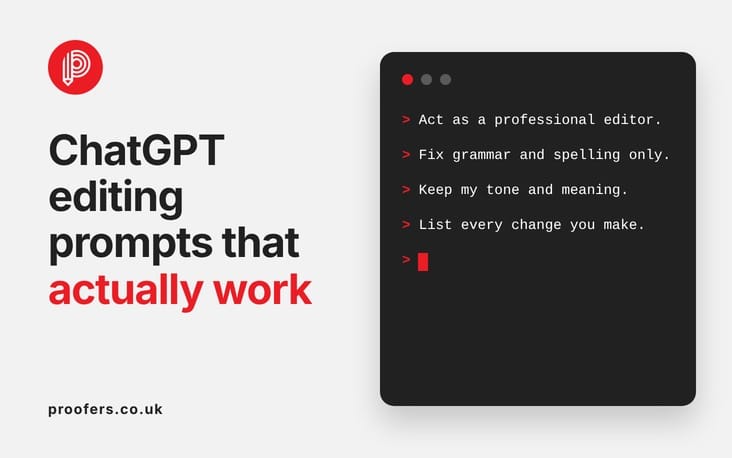
The right ChatGPT prompt makes all the difference. Here are the editing and proofreading prompts that get targeted results - without unwanted rewrites.