“Turnitin cannot prove you used ChatGPT — it flags statistical patterns for human review. The judgement is always made by your tutor, not the software.”
Want to know your AI detection score before your university does? Our AI checking service uses Turnitin to give you a full AI detection report — the same technology your university uses. Get an instant quote.
How AI Detection Actually Works
AI detection tools work by analysing statistical patterns in text. Large language models like ChatGPT generate text by predicting the most probable next word at each step — which means AI-generated writing tends to be highly predictable in its word choices, sentence structure and phrasing. AI detection tools measure this predictability.
When you submit a document to a tool like Turnitin’s AI writing detection, the software analyses your text and calculates a score representing the proportion it believes was generated by AI. It does not compare your text against a database of known AI outputs — it analyses the text itself for the statistical fingerprints of machine-generated language.
This is an important distinction. It means:
- AI detection does not know which specific AI tool was used
- It cannot prove that you used ChatGPT — only that sections of your text share characteristics with AI-generated content
- It looks at the text as a whole, not individual sentences in isolation
According to guidance published by Jisc — the UK’s leading body on technology in education — AI detection tools are one of several approaches universities are adopting to identify AI-generated content, but they are not the only one, and they are not infallible.
What Turnitin’s AI Detection Can and Cannot Do
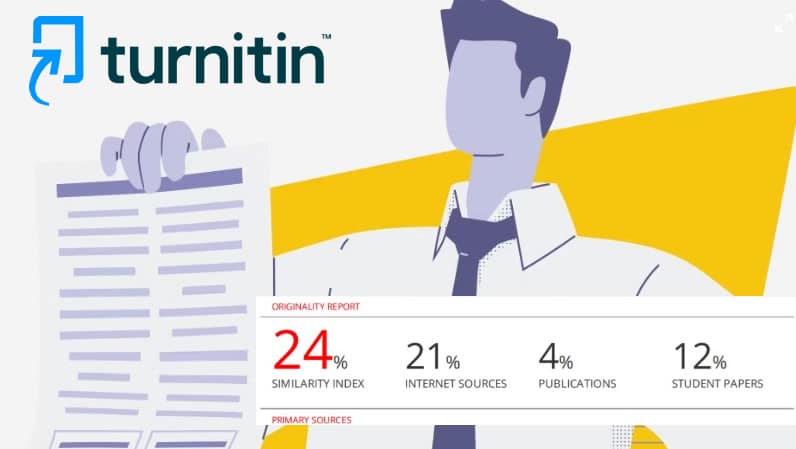
Turnitin is the most widely used plagiarism and AI detection platform in UK higher education. In 2023, Turnitin launched its AI writing detection feature, which is now integrated into the standard submission process at most UK universities.
What Turnitin Can Do
- Identify text that shares statistical characteristics with AI-generated content
- Produce a percentage score indicating how much of a submission it believes is AI-generated
- Highlight specific passages that triggered the AI detection
- Flag submissions for human review by your tutor or academic integrity team
What Turnitin Cannot Do
- Prove with certainty that you used ChatGPT or any specific AI tool
- Detect AI use that has been thoroughly rewritten and edited by a human
- Distinguish between AI-generated text and text written by a human who happens to write in a clear, structured way
- Access your browser history, ChatGPT account or any external data source
It is also worth noting that Turnitin’s AI detection has a known false positive rate — meaning it can flag human-written text as AI-generated, particularly for non-native English speakers whose writing may be more structurally predictable. Turnitin itself acknowledges this limitation in its documentation.
How Accurate Is AI Detection?
This is where the picture becomes more nuanced. AI detection technology is improving rapidly, but it is not perfectly accurate — and both false positives and false negatives occur.
A false positive occurs when a tool incorrectly identifies human-written text as AI-generated. This is a genuine problem — research has shown that some AI detectors flag non-native speakers’ writing at significantly higher rates than native speakers, which raises serious concerns about fairness.
A false negative occurs when genuinely AI-generated text is not detected. This is more likely when the AI output has been substantially rewritten, edited or paraphrased by a human — which is precisely why AI detection alone is rarely the only mechanism universities use to investigate suspected misuse.
In practice, most UK universities treat a high AI detection score as a trigger for further investigation, not as automatic proof of misconduct. A tutor who knows your previous work, writing style and capabilities is often better placed to identify genuine AI use than any automated tool.
Check your AI score before submission. Our AI checking service uses Turnitin to give you the same report your university will see — so there are no surprises on submission day. Get an instant quote.
What Are UK Universities’ Policies on AI?
UK universities have moved quickly to establish AI policies, but they vary significantly between institutions — and even between departments within the same university. As of 2026, the broad landscape looks like this:
Full Prohibition
Some universities and departments prohibit any use of AI tools in assessed work without exception. Submitting AI-generated content at these institutions is treated as academic misconduct equivalent to plagiarism, with potential consequences including module failure, suspension or degree withdrawal.
Permitted with Disclosure
A growing number of universities permit the use of AI as a tool — for brainstorming, research assistance or drafting — provided the student discloses how it was used. The final submitted work must still be substantially the student’s own writing and analysis.
Task-Specific Guidance
Many universities take a task-by-task approach — permitting AI assistance for some assignments while prohibiting it for others. The most important thing you can do is check your own institution’s current policy. Your university’s student handbook, module information and academic integrity policy are the definitive sources.
What If You Have Already Used ChatGPT?
If you have already used ChatGPT to write or contribute to a piece of assessed work and you are concerned about detection, your options depend on how much of the work is AI-generated and how close you are to the submission deadline.
If the Work Is Substantially AI-Generated
The most important thing is not to submit work that violates your university’s policy. The consequences of being caught are far more serious than the consequences of asking for an extension, rewriting the work, or speaking to your tutor about the situation. Most universities have support mechanisms for students who are struggling — use them.
If the Work Uses AI as a Starting Point
If you have used ChatGPT to generate a draft that you have then substantially rewritten, expanded and developed with your own analysis, the situation is different. The key question is whether the final submission genuinely reflects your own thinking and writing — and whether your institution’s policy permits this level of AI assistance.
If you are concerned about your AI detection score, our AI content editing service can rewrite and humanise AI-generated passages so they read as natural, human-authored content. Combined with a follow-up AI check, this gives you a clear picture of where you stand before you submit.
Your Options Going Forward
Whatever your current situation, here are the sensible steps to take going forward:
1. Check Your Institution’s Policy
Before using any AI tool for assessed work, read your university’s current AI policy. Do not rely on what you heard from other students — policies have changed rapidly and vary between courses and assignments.
2. Use AI as a Tool, Not a Ghostwriter
Using AI to help you research, brainstorm, outline or check your own writing is very different from using it to generate the work itself. The former is increasingly accepted; the latter is not. The distinction that matters is whether the ideas, analysis and writing are genuinely your own.
3. Check Your AI Score Before Submission
If you are unsure whether your submission might trigger AI detection, check it yourself first. Our AI checking service uses Turnitin — the same tool your university uses — and returns a detailed report within 24 hours. Your document is not added to any database, so it will not affect your actual submission.
4. Get Professional Help with Rewriting
If your AI check reveals a high AI detection score and you need to rewrite sections before submission, our AI content editing service can help — you can also read our guide to the best AI content editing services in the UK to understand your options. Our editors rewrite AI-generated passages to sound natural, polished and human — preserving your intended meaning while significantly reducing your AI detection score.
Know your score before your university does.
Our Turnitin-powered AI checking service returns a full detection report within 24 hours. Your document is never added to any database. Full money-back guarantee.
Frequently Asked Questions
Can universities detect ChatGPT?
Yes — most UK universities now use Turnitin’s AI detection feature, which analyses text for the statistical patterns characteristic of AI-generated content. However, detection is not infallible. Thoroughly rewritten AI content is harder to detect, and false positives do occur. A high AI detection score will typically trigger further investigation rather than automatic disciplinary action.
Does Turnitin know if I used ChatGPT?
Turnitin cannot identify which specific AI tool was used. It analyses the text itself for statistical patterns associated with AI-generated content and produces a percentage score. It has no access to your browser history, ChatGPT account or any external data. What it can do is flag your submission for human review if the score is high.
What happens if my university thinks I used AI?
A high AI detection score will typically result in your submission being flagged for review by your tutor or academic integrity team. They will look at the full context — your AI score, your previous work, your writing style, and any other relevant factors — before deciding whether to pursue an academic misconduct investigation.
Is using ChatGPT to help with an essay cheating?
This depends entirely on your university’s policy and how you have used it. Using ChatGPT to research a topic, generate ideas or check your grammar is very different from using it to write your essay for you. Check your institution’s current AI policy for your specific course and assignment — and when in doubt, ask your tutor.
Will rewriting ChatGPT output lower my AI detection score?
Yes — substantially rewriting AI-generated content significantly reduces the likelihood of detection. Superficial changes are less effective. Genuine rewriting — changing sentence structure, adding specific detail, introducing your own voice — is much more effective. For the most reliable results, our AI content editing service provides professional humanisation of AI-generated text.
Summary
- UK universities use Turnitin’s AI detection to identify AI-generated content — but it is not infallible
- Turnitin cannot prove you used ChatGPT — it flags statistical patterns for human review
- University AI policies vary significantly — always check your own institution’s current guidance
- A high AI detection score triggers investigation, not automatic disciplinary action
- Thoroughly rewritten AI content is harder to detect than lightly edited output
- Checking your AI score before submission gives you time to act if needed
Submit your document today for a professional AI check or AI content edit — returned within 24 hours with a full money-back guarantee.