Why Free Paraphrasing Tools Fail (And What to Use Instead)
Posted on 20th October by Admin
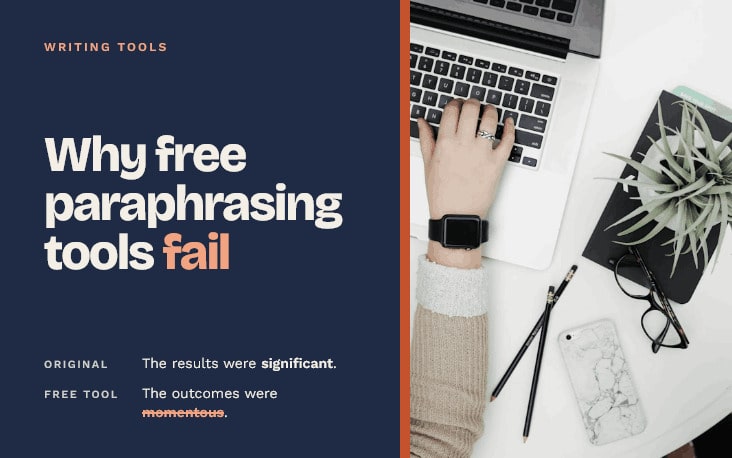
Free paraphrasing tools are tempting – they are instant, they are free and they promise to rewrite your text at the click of a button. But for anything that matters, they almost always fall short. From robotic phrasing and lost meaning to accidentally increasing your plagiarism score, the gap between what these tools promise and what they deliver is significant.
This guide breaks down exactly why free paraphrasing tools fail, when they might be good enough, and what a professional paraphrasing service does differently – so you can make an informed decision before trusting your work to an algorithm.
Need accurate, natural-sounding paraphrasing? Our professional paraphrasing service rewrites your content with meaning, tone and context fully preserved.
What Free Paraphrasing Tools Actually Do
Free online paraphrasing tools – sometimes called spinners, rewriters or AI paraphrasers – work by substituting words and phrases with synonyms, restructuring sentences algorithmically, or feeding your text through a large language model trained to rephrase content quickly.
They are fast, free and require no skill to use. But speed and zero cost come at a price. Most free tools are optimised for output volume, not output quality. They do not understand your text – they pattern-match it. The result is often a version of your original that is technically different but practically worse.
Understanding how they work helps explain why they so often fall short.
5 Reasons Free Paraphrasing Tools Fall Short
1. They swap words, not meanings
The most basic free tools use synonym replacement – swapping individual words for alternatives from a thesaurus. The problem is that synonyms are rarely interchangeable without changing meaning or register. A tool might replace happy with ecstatic, or said with articulated, producing text that is technically paraphrased but tonally wrong and sometimes nonsensical.
Context matters enormously in language. A tool that does not understand context cannot reliably preserve it.
2. The output sounds robotic
Even more sophisticated AI paraphrasers frequently produce text that sounds stilted, unnatural or awkward. Phrases that work perfectly well in the original become clunky after processing. Sentence rhythms change in ways that disrupt the flow of an argument. Readers notice – even if they cannot always say exactly what is wrong.
This is particularly damaging in academic, professional or creative writing, where voice, tone and fluency matter as much as accuracy.
3. They struggle with specialist or technical language
Free tools are trained on general text. They often mishandle technical terminology, academic jargon, legal language or industry-specific phrasing. A tool might paraphrase a precise technical term into a vague general word, or substitute a defined term with a synonym that has a different meaning in the relevant field. In academic writing, this can introduce factual errors.
4. They lose your argument structure
Good writing is not just correct sentences – it is sentences that build an argument, develop an idea or tell a story. Free paraphrasing tools process text at the sentence or paragraph level. They rarely grasp the logical structure of a piece or the way each part relates to the whole. The result can be a collection of individually paraphrased sentences that no longer connect coherently.
5. Quality control is zero
A free tool has no quality gate. It outputs whatever it produces without review. There is no check for accuracy, no sense of whether the paraphrase has improved or degraded the original, and no accountability if the result is wrong. You are entirely on your own when it comes to assessing whether the output is actually usable.
The Plagiarism and AI Detection Risk
Many people turn to free paraphrasing tools specifically to avoid plagiarism detection. This strategy frequently backfires for two reasons.
Paraphrasing tools do not guarantee plagiarism-free output
Superficial word substitution often leaves the underlying sentence structure intact. Plagiarism detection tools like Turnitin are sophisticated enough to identify paraphrased plagiarism – sometimes called mosaic plagiarism – where the structure and ideas of a source are reproduced even if individual words have been changed. A free spinner will not protect you from this.
AI detection tools flag spinner output
There is a further irony: text processed through many free paraphrasing tools can actually increase your AI detection score rather than reduce it. AI detectors look for unnatural phrasing, inconsistent register and the kind of awkward sentence constructions that spinners frequently produce. Content that has been heavily processed by a free tool often reads more like AI-generated text than the original did.
If you are concerned about plagiarism or AI detection, the solution is not a free spinner – it is genuine rewriting that changes structure, language and expression while preserving the underlying meaning and argument. That requires human skill.
To be fair, free paraphrasing tools are not useless in every situation. There are contexts where the output quality is sufficient:
Rough first drafts – if you need a starting point to edit from rather than a finished piece, a free tool can give you something to work with
Low-stakes internal notes – where the audience is yourself or a small team and polish does not matter
Quick idea generation – where you want to see alternative ways of expressing something before writing your own version
Simple, short sentences – the simpler the original text, the better most tools perform
If your text needs to be submitted, published, sent to a client, assessed academically or read by anyone who will judge it – a free tool is unlikely to produce work that meets that standard without significant manual editing on your part.
What a Professional Paraphrasing Service Does Differently
A professional paraphrasing service does not run your text through an algorithm. It assigns a human editor – someone who reads your content, understands its purpose, and rewrites it with full awareness of meaning, tone, audience and context.
Free Tool
Professional Service
Synonym substitution or AI pattern-matching
Human editor reads and rewrites with full understanding
Meaning often distorted or lost
Meaning, argument and intent preserved throughout
Tone and register frequently wrong
Tone matched to audience and purpose
Technical language mishandled
Specialist terminology handled correctly
No quality check
Reviewed before delivery
Output may increase AI detection score
Natural, human-sounding output
The difference is most visible in complex, high-stakes documents – academic work, business reports, legal summaries, published content. These are precisely the cases where getting it right matters most, and where a free tool is least likely to deliver.
Side-by-Side Examples
Here is how a typical free tool compares to professional paraphrasing on a short academic passage.
Original text:
The findings suggest a significant correlation between sleep deprivation and reduced cognitive performance, particularly in tasks requiring sustained attention and working memory.
Free tool output:
The discoveries recommend a huge connection between rest hardship and diminished mental execution, especially in assignments requiring supported consideration and working memory.
The free tool has replaced findings with discoveries, suggest with recommend, sleep deprivation with rest hardship, and cognitive performance with mental execution. Each substitution is wrong – either in meaning, register or both. The result is neither academic nor accurate.
Professional paraphrase:
The results indicate a strong link between lack of sleep and poorer cognitive function, with particular impact on tasks that demand sustained concentration and working memory.
The professional version preserves the academic register, keeps the precise meaning intact, and reads naturally – ready to submit without further editing.
Frequently Asked Questions
Are any free paraphrasing tools actually good?
Some free tools are better than others – particularly those powered by newer large language models. However, even the best free tools lack the contextual understanding, subject knowledge and quality review that a human editor brings. For anything that will be read critically, professionally edited paraphrasing is worth the investment.
Is using a paraphrasing tool cheating?
It depends entirely on the context. Using a paraphrasing tool to improve your own writing or rephrase content you have written is generally fine. Using one to disguise someone elses work as your own, or to circumvent academic integrity requirements, is a form of academic misconduct. Always check the rules of your institution or publisher.
Will Turnitin detect paraphrased text?
Yes – Turnitin and similar tools are increasingly effective at identifying paraphrased plagiarism, including mosaic plagiarism where structure and ideas are borrowed even if individual words are changed. See our guide on whether Turnitin can detect paraphrasing for more detail.
How much does a professional paraphrasing service cost?
Costs vary depending on word count, turnaround time and complexity. Visit our paraphrasing service page for current pricing.
Can I use a free tool and then have it professionally edited?
Yes – this is a reasonable approach for longer documents on a budget. Run the text through a free tool for a rough first pass, then have a professional editor review and correct the output. Bear in mind that heavily spun text can take longer to edit than the original would have done.
Ready for professional paraphrasing? Our editors rewrite your content accurately, naturally and to the standard your audience expects.
Confused about the difference between a plagiarism checker and an AI checker? This guide explains exactly what each tool does, when to use them, and why you might need both.