AI Content Detection Statistics 2026: Accuracy, False Positives and Key Data
Posted on 22nd October by Admin
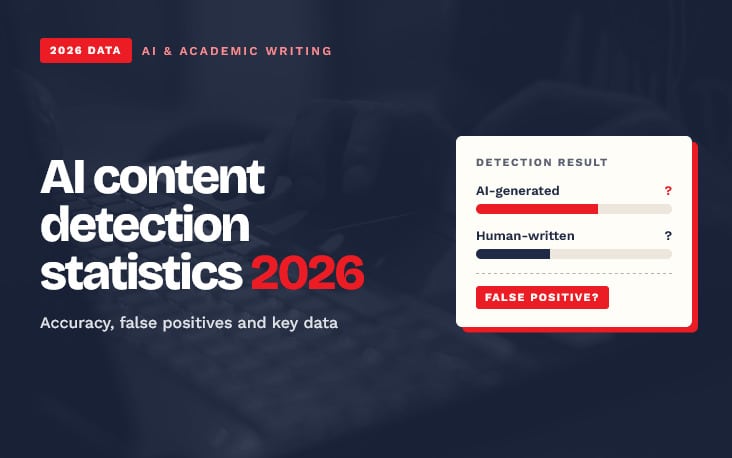
AI content detection tools are now used by universities, publishers and employers across the UK and beyond — but how accurate are they, and what does the data actually say? These AI content detection statistics bring together the latest research on detection rates, false positive risks, institutional adoption and the growing market for AI checking tools in 2026.
Whether you are a student concerned about unfair flagging, an academic institution reviewing your policies, or a content team navigating AI disclosure requirements, the figures below give you a clear picture of where the technology stands. Every statistic on this page is fully sourced from named research, independent surveys and published industry data — so you can use these figures with confidence.
Key AI Detection Statistics at a Glance
Here are the headline figures from our research — all fully sourced below.
74.2% of newly created web pages now contain AI-generated content, according to an Ahrefs study of 900,000 pages.
3.3% of 65 million papers reviewed by Turnitin were flagged as having at least 80% AI-written content.
10.3% of those papers showed more than a fifth of their text as AI-written.
61.3% of non-native English student essays were falsely flagged as AI-written in a Stanford University study.
75% of UK students who use AI report stress about being wrongly flagged by detection tools.
The global AI content detection market is projected to grow from $0.58 billion in 2025 to $2.06 billion by 2030.
OpenAI shut down its own AI detector in 2023 after it achieved just 26% accuracy on AI-generated text.
Need your AI-assisted content checked and edited by a human? Our AI content editing service ensures your writing reads as authentically human — and passes any scrutiny.
How Accurate Are AI Content Detectors?
Vendor accuracy claims vary widely — and independent testing tells a very different story.
What vendors claim
Tool
Claimed Accuracy
Claimed False Positive Rate
GPTZero
99.76%
0.08%
Originality.AI
99%+
0.5–1.5%
Copyleaks
99.12%
Under 1%
Turnitin
98%
Under 1%
What independent testing shows
The gap between vendor claims and real-world performance is significant:
A Frontiers in AI study (2024) found detector accuracy ranges from just 65% to 90% in practice — far below vendor claims.
Scribbr tested 12 tools and found Copyleaks achieved only 66% accuracy against its claimed 99.12%.
The RAID benchmark — an independent academic study by researchers at UPenn, UCL, King’s College London and Carnegie Mellon — tested 12 detectors across 6.2 million texts and 11 AI models. Results showed significant performance drops when text was lightly edited or paraphrased.
When AI-generated content was rewritten even slightly, detection rates fell to just 22.1% in some tests.
OpenAI launched its own classifier in January 2023 and shut it down six months later. Its accuracy on AI-generated text was just 26%, with a 9% false positive rate on human text — described by OpenAI itself as “very unreliable.”
The takeaway is clear: no AI detector is reliable enough to use as sole evidence of misconduct. Independent researchers, universities and legal bodies are increasingly reaching the same conclusion.
Worried your AI-assisted work could be flagged?
Our editors review AI-generated and AI-assisted content to ensure it reads naturally, maintains your voice and meets academic or professional standards.
Perhaps the most concerning issue with AI detection is how often it wrongly flags genuine human writing — with serious consequences for students and professionals.
Non-native English speakers are disproportionately affected
A landmark study by Stanford University researchers, published in the journal Patterns, tested seven leading AI detectors on 91 TOEFL essays written by non-native English speakers:
61.3% of TOEFL essays were falsely identified as AI-written on average.
97.8% of essays were flagged by at least one detector.
19.8% of essays were flagged as AI-written by all seven detectors simultaneously.
By contrast, US 8th-grade essays (native speakers) had a false positive rate of around 3%.
The research highlights a serious bias: detectors associate clear, simple sentence structures — common in non-native writing — with AI output. This puts international students at significant risk of wrongful accusations.
The scale of the problem at universities
Turnitin’s own documentation acknowledges a roughly 4% per-sentence false positive rate.
At a 1–2% false positive rate across a 20,000-student university, between 200 and 400 students could be wrongly flagged each year.
Vanderbilt University disabled Turnitin’s AI detector in 2023, calculating that even at a 1% false positive rate across 75,000 papers, around 750 students per year would be incorrectly accused.
The UK’s Office of the Independent Adjudicator published six case summaries in July 2025 involving wrongful AI detection — including one case where an autistic student received a zero.
Research from the University of Nebraska-Lincoln found higher flagging rates for students with autism, ADHD and dyslexia, whose writing patterns can resemble AI output.
UK universities are grappling with how to respond to the rise of AI tools — and the picture is rapidly changing.
71% of UK students now use AI for their studies, up from 64% in 2025, according to a Studiosity and YouGov survey of over 2,300 students at 160 UK universities.
75% of UK students who use AI report anxiety about being wrongly flagged by detection tools.
81% of international students experience this anxiety, compared with 74% of domestic students.
52% of AI-using students name the fear of wrongful accusation as a top stressor.
A HEPI study of 96 UK universities (2026) found significant inconsistency in how institutions define and enforce AI policies.
Some UK universities have now dropped AI detection tools entirely over accuracy concerns, according to reporting in 2026.
The trend is clear: detection-first approaches are losing credibility in UK higher education, with growing calls for universities to focus on assessment design rather than surveillance. If you are a student concerned about your work, our AI checking service can help you understand how your document may be perceived before you submit.
Market Growth and Adoption
Despite questions over accuracy, the AI detection industry is growing rapidly.
The global AI content detection market is projected to reach $2.06 billion by 2030, up from $0.58 billion in 2025 — a compound annual growth rate of 28.8% (MarketsAndMarkets).
A separate estimate puts the market at $6.96 billion by 2032, with a 21.4% CAGR (Coherent Market Insights).
The academic integrity segment holds the largest share of the current market.
AI-generated audio and voice detection is the fastest-growing segment.
As of mid-2023, 98% of Turnitin-affiliated institutions had AI writing detection enabled in at least one active account.
Turnitin has reviewed more than 65 million papers since its AI detection feature launched in April 2023.
Of those, over 2.1 million (3.3%) were flagged as having at least 80% AI-written content.
74.2% of newly created web pages contain AI content, per an Ahrefs study — creating a growing demand for detection at scale beyond academia.
Can AI Detection Be Bypassed?
The short answer is yes — and the data shows it is becoming easier.
When AI-generated text was lightly rewritten, detector accuracy fell from around 85% to just 22.1% in some tests.
“Humanizer” tools — software designed to rewrite AI content to evade detection — achieved an average 47.4% bypass rate against major detectors (QuillBot AI Humanizer, per Anangsha Alammyan’s 2026 test of 30+ tools).
Top-tier structural humanizers achieved bypass rates of over 70% against specific detectors.
Simply having ChatGPT rewrite its own output in more literary language reduced detection to near zero across seven detectors in one test.
In a study of 192 texts, false positive rates for real student writing ranged from 43% to 83% depending on the tool used.
This creates a troubling situation: detectors struggle to catch sophisticated AI use, while simultaneously flagging genuine human writing. The result is a tool that penalises innocent students while doing little to deter deliberate misuse.
Our UK-based editors work with AI-assisted and AI-generated content every day. We ensure your writing is polished, credible and reads as authentically yours.
Vendor claims of 98–99% accuracy are not supported by independent testing. Real-world studies suggest accuracy ranges from 65% to 90%, and drops significantly when text has been lightly edited or paraphrased.
Can AI detectors wrongly flag human writing?
Yes. This is one of the most significant problems with current AI detection tools. Non-native English speakers, students with autism or dyslexia, and anyone who writes in a clear, concise style are at elevated risk of being falsely flagged.
Do UK universities use AI detectors?
Many do, but confidence in these tools is declining. Several UK universities have dropped AI detection tools entirely in 2026 due to accuracy concerns and the risk of wrongful accusations. HEPI research found significant inconsistency in AI policies across 96 UK institutions.
What is a false positive in AI detection?
A false positive occurs when an AI detector incorrectly flags human-written content as AI-generated. This is a serious issue — in the Stanford study, 61.3% of non-native English essays were falsely identified as AI-written.
Can AI detection be avoided?
Yes — research shows that even minor edits to AI-generated text significantly reduce detection rates. However, the better approach for students and professionals is to use AI as a starting point and have a human editor refine the work, ensuring it reflects genuine thought and meets the required standard.
All statistics on this page are sourced from named academic studies, independent research and published industry reports. Sources include Stanford University (Zou et al., Patterns, 2023), Turnitin press releases, Studiosity/YouGov (2026), MarketsAndMarkets, Coherent Market Insights, Ahrefs, Frontiers in AI (2024), and the RAID benchmark study (UPenn, UCL, King’s College London, CMU).
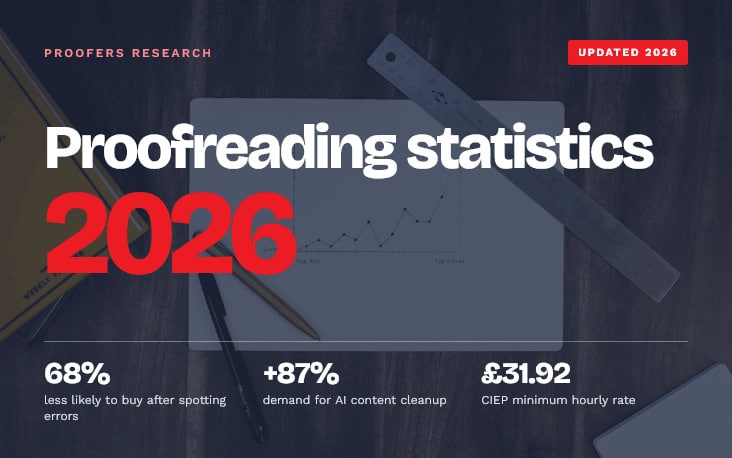
How much do spelling errors actually cost businesses? How many UK consumers lose trust in brands that make written mistakes? This roundup of 40+ proofreading statistics for 2026 covers the real data — from the cost of typos to UK professional editing rates and the rise of AI content editing demand.
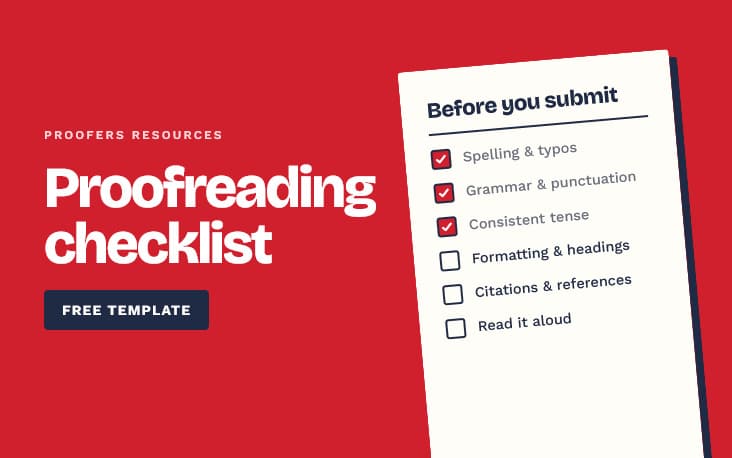
A free, comprehensive proofreading checklist covering spelling, grammar, punctuation, consistency, formatting and references — with practical tips for catching errors before you submit any document.
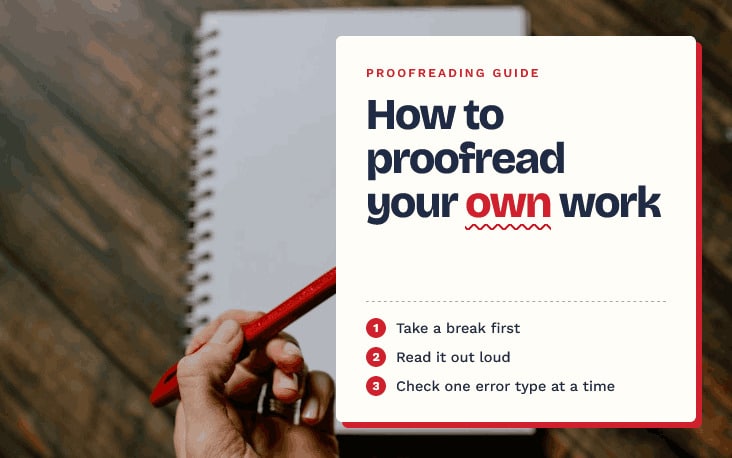
Learn how to proofread your own work effectively with our step-by-step guide. Discover proven techniques, the most common errors to watch for, and when it is worth using a professional proofreader.