Proofreading Statistics 2026: Key Data on Errors, Costs and the Editing Industry
Posted on 22nd October by Admin
From the cost of a single typo to the surge in demand for AI content editing, these proofreading statistics reveal just how much written accuracy matters in 2026. Whether you are a business owner protecting your brand, a student submitting a dissertation or a content team working with AI-generated copy, the data tells the same story: errors cost you credibility, customers and conversions.
Every statistic on this page is fully sourced from named research, independent surveys and official industry bodies — so you can use these figures with confidence.
Need professional proofreading? Our UK-based editors are ready to help. Use our free price calculator to get an instant quote — no sign-up required.
Key Proofreading Statistics at a Glance
Here are the headline figures from our research — all fully sourced below.
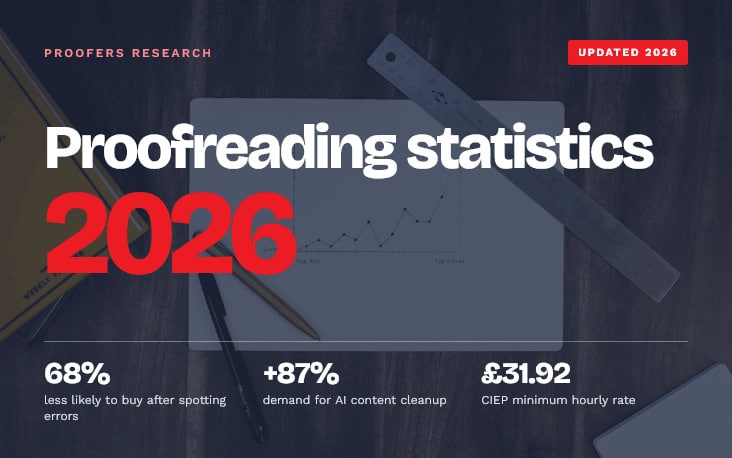
68% of UK adults say they are less likely to buy from a brand whose marketing contains spelling or grammar errors.
73% of UK adults say their view of a brand worsens after noticing written mistakes.
Fixing a single spelling error on one e-commerce website doubled online sales, according to research by entrepreneur Charles Duncombe.
Demand for AI content cleanup work on Freelancer.com rose 87% between August 2025 and June 2026.
The CIEP’s suggested minimum rate for professional proofreading in the UK is £31.92 per hour (from March 2026).
Searches for AI content cleanup services on Fiverr grew more than 20 times between 2023 and 2026.
A Master’s dissertation typically runs to 15,000–20,000 words — which could contain hundreds of errors if left unproofread.
77% of UK adults over 55 say they would think less of a brand that made written mistakes.
Spelling Errors and Consumer Trust
The most significant body of research on proofreading concerns how consumers respond to written errors. The findings are consistent: mistakes damage credibility, undermine trust and reduce the likelihood of purchase.
How Spelling and Grammar Errors Affect Purchasing Decisions
A 2022 survey of UK adults conducted by Opinium for Accuracy Matters produced some of the most detailed consumer data on the impact of written errors:
68% of UK adults said they would be less likely to buy from a brand whose messaging contained spelling or grammar errors.
73% of UK adults said their view of a brand would worsen after noticing such errors.
Among women, 71% said errors would make them less likely to buy — compared with 65% of men.
Among over-55s, 71% said errors would hurt their purchasing decisions.
Even among the most forgiving age group (18–34-year-olds), 65% said errors would make them less likely to buy. Notably, 10% of this group said errors would actually improve their view of a brand — the only age group to respond this way.
77% of over-55s said they would think less of a brand that made written mistakes — the highest of any age group.
Trust and Credibility
The connection between written accuracy and perceived credibility is well established. When a business or individual makes spelling or grammar errors in public-facing content, the effect on perceived trustworthiness is immediate and measurable:
Research consistently shows that consumers equate written errors with a lack of professionalism and attention to detail — qualities that directly affect purchasing confidence.
UK consumers are among the most sensitive to written errors in Europe, reflecting both high literacy rates and strong cultural expectations around written English in business communication.
The BBC and Charles Duncombe’s research found that internet sales conversion rates may be cut in half by a single spelling error — the most cited individual finding in this space.
The financial impact of spelling and grammar errors on businesses is well documented — though the headline numbers often understate the true scale of the problem, because reputation damage and lost conversions are difficult to quantify precisely.
Revenue and Sales Impact
Internet entrepreneur Charles Duncombe measured revenue per visitor to his website before and after correcting a single spelling error. Fixing one typo doubled his online sales. The BBC reported this finding as part of a wider story on the cost of poor spelling in e-commerce. (Source: Stratton Craig)
UK internet sales exceed £527 million per week according to Office for National Statistics figures — a market in which even a fractional conversion rate loss to poor copy translates into millions of pounds of missed revenue.
The Confederation of British Industry (CBI) has reported that literacy problems are increasingly serious among member companies, with growing employer demand to fund literacy training for staff.
In 2010, the Chilean mint produced over one million 50-peso coins with the country’s name misspelled as “C-H-I-I-E.” The coins circulated for a year before the error was noticed. The mint’s general manager was fired. The reputational cost to a national institution from a single proofreading failure was significant and lasting. (Source: Stratton Craig)
Professional and Reputational Costs
Legal and financial documents with errors can result in significant contractual disputes and liability. Proofreading in high-stakes professional contexts is not a quality-of-life improvement — it is a legal and commercial necessity.
Academic journal submissions with language errors are frequently rejected before peer review begins. Professional editing directly affects academic career prospects and publication success rates.
Job applications with spelling errors are consistently ranked lower by recruiters. Multiple studies have found that a single spelling mistake on a CV can result in automatic rejection, regardless of the candidate’s qualifications.
Professional Proofreading Rates in the UK
Professional proofreading in the UK is governed by suggested minimum rates published by the Chartered Institute of Editing and Proofreading (CIEP). These rates are updated annually and reflect the professional standard expected of qualified editors and proofreaders.
CIEP Suggested Minimum Rates (2026–27)
Type of Work
Suggested Minimum Rate (per hour)
Proofreading
£31.92
Copyediting
£37.11
Substantial editing / rewriting / development editing
While the CIEP publishes hourly rates, most online proofreading services — including Proofers — charge per 1,000 words, which is more transparent and predictable for customers.
Service Level
Typical Rate (per 1,000 words)
Proofreading
£10–£20
Copy editing
£15–£25
Substantive / developmental editing
£25–£50+
AI content editing
£20–£35
At Proofers, proofreading starts from £10 per 1,000 words and copy editing from £15 per 1,000 words — among the most competitive rates offered by a professional UK-based service. Use our price calculator for an instant quote.
AI Content and the Rise of Editing Demand
The widespread adoption of AI writing tools since 2022 has had a profound and measurable effect on the demand for human editing and proofreading. The data paints a clear picture: AI is generating more content than ever, and that content needs human review.
The Growth of AI Content Editing as a Service
Demand for AI content cleanup work on Freelancer.com — jobs listed with terms like “fix AI,” “AI hallucination” or “AI error” — rose 87% between August 2025 and June 2026, reaching 10,760 active listings. (Source: Forklog)
On Upwork, demand for specialists to fix AI-generated content grew 70% year over year. Since 2023, such openings in development have risen 8.3 times, and in design and creative roles, 7.9 times. (Source: Forklog)
Searches for AI content cleanup services on Fiverr grew more than 20 times between 2023 and 2026. (Source: Forklog)
Editor Kim Dunbar reported that fixing AI-generated text accounts for approximately 60% of her working time. She has edited around 40 AI-generated books, long-form pieces and technical materials since 2024. (Source: Forklog)
Why AI Content Needs Human Proofreading
The most common issues identified by professional editors reviewing AI-generated content include:
Repetition — AI tools frequently repeat phrases, sentence structures and ideas across long documents.
Unnatural paragraph structure — AI writing often lacks the organic flow of human-written text, producing rigid or formulaic paragraphs.
Lack of emotional nuance — AI content can be technically accurate but tone-deaf, missing the register appropriate for the audience and context.
Hallucinated facts and citations — AI tools sometimes generate plausible-sounding but entirely false statistics, quotes or references.
Style inconsistency — Longer AI documents often shift in voice, formality or terminology without a human editor to maintain consistency.
Our AI content editing service is specifically designed to address these issues — transforming AI-generated drafts into polished, publication-ready content.
Academic documents represent one of the largest segments of the professional proofreading market in the UK. Students submitting dissertations and theses are among the most active users of proofreading services — for good reason.
Dissertation and Thesis Statistics
An undergraduate dissertation in the UK typically runs to 8,000–12,000 words.
A Master’s dissertation typically runs to 15,000–20,000 words.
A PhD thesis in the UK typically runs to 80,000–100,000 words — making professional proofreading both more complex and more valuable at this level.
At a writing speed of 500 words per hour, a Master’s student may spend 30–40 hours writing their dissertation — an investment that a few hours of professional proofreading can meaningfully protect.
Professional proofreading is permitted by most UK universities, provided the student writes the content and the proofreader corrects only language, not ideas or argument. Scribbr and the QAA guidelines both confirm that language proofreading is generally acceptable academic practice.
The Cost of Proofreading for Students
Document Type
Typical Word Count
Proofreading Cost at Proofers
Undergraduate dissertation
8,000–12,000 words
£80–£120
Master’s dissertation
15,000–20,000 words
£150–£200
PhD thesis
80,000–100,000 words
£800–£1,000
Short essay (2,000 words)
2,000 words
£20
Use our price calculator for an exact quote based on your specific word count and deadline.
Ready to get your document proofread?
Our UK-based editors are ready to help — whether it is a dissertation, a business report or AI-generated content that needs a human touch. All orders include a full money-back guarantee.
How many people use proofreading services in the UK?
Precise figures on total UK proofreading service usage are not publicly available, but the market is substantial. The UK is home to thousands of freelance proofreaders and copy editors, plus a growing number of professional online services. Demand is driven primarily by students (dissertations and theses), business professionals (reports, proposals, marketing materials) and increasingly by businesses needing to edit AI-generated content.
Do spelling errors really affect business sales?
Yes — and the evidence is striking. Research by Charles Duncombe found that fixing a single spelling mistake on his website doubled online sales. A 2022 UK consumer survey found 68% of adults would be less likely to buy from a brand with spelling errors in its marketing. The data consistently shows that written accuracy is directly connected to perceived credibility and purchase intent.
What is the average cost of professional proofreading in the UK?
Professional proofreading in the UK typically costs between £10 and £20 per 1,000 words for a standard turnaround. The Chartered Institute of Editing and Proofreading (CIEP) suggests a minimum hourly rate of £31.92 for proofreading work (from March 2026). At Proofers, proofreading starts from £10 per 1,000 words. Use our price calculator for an instant quote.
Is demand for proofreading increasing?
Yes — particularly for AI content editing. While some traditional proofreading demand has shifted, the explosion of AI-generated content has created a significant new market for human editors who can fix errors, improve tone and ensure accuracy. Demand for AI cleanup work on major freelance platforms grew by 70–87% in the year to mid-2026.
How does AI content affect the need for proofreading?
AI-generated content typically contains a range of errors that require human correction: repetition, unnatural phrasing, hallucinated facts, inconsistent tone and style drift. As AI writing tools become more widely used, the demand for human proofreaders and editors who can review and improve AI content has grown sharply. Our AI content editing service is designed specifically for this use case.
Are these statistics regularly updated?
We aim to update this page annually with the latest data. If you notice a statistic that needs updating, or have data you would like us to include, contact us. All statistics on this page are sourced from named research, surveys or official bodies — we do not publish unverified claims.
Summary
68% of UK adults are less likely to buy from brands with spelling or grammar errors (Accuracy Matters / Opinium, 2022)
73% of UK adults say their view of a brand worsens after noticing written mistakes
Fixing a single typo doubled online sales for one UK e-commerce site (Charles Duncombe / BBC)
AI content cleanup demand on Freelancer.com rose 87% in under 12 months
The CIEP minimum rate for professional proofreading is £31.92 per hour (2026–27)
Proofreading demand is growing — driven by AI content, student dissertations and business communications
If you need professional proofreading for bour document, our UK-based team is ready to help. Submit your document today and get it back polished, accurate and error-free — backed by a full money-back guarantee.
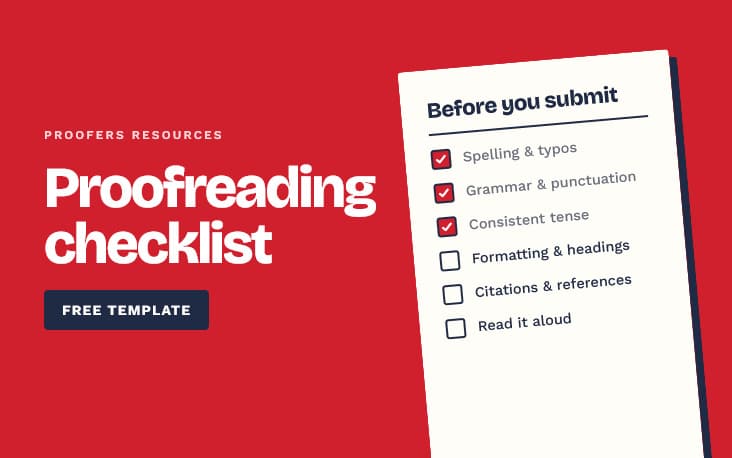
A free, comprehensive proofreading checklist covering spelling, grammar, punctuation, consistency, formatting and references — with practical tips for catching errors before you submit any document.
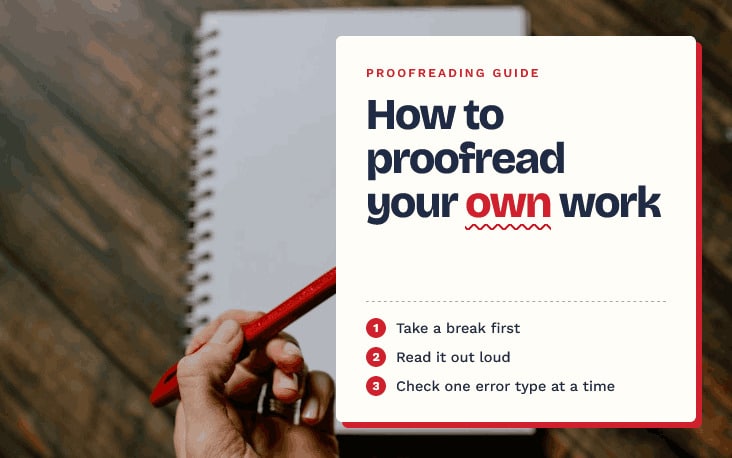
Learn how to proofread your own work effectively with our step-by-step guide. Discover proven techniques, the most common errors to watch for, and when it is worth using a professional proofreader.
Not sure which proofreading service to choose? We compare the best UK proofreading services in 2026 — including price, turnaround time, quality and guarantees — so you can make the right decision.