Free Proofreading Checklist (2026): Every Error to Check Before You Submit
Posted on 22nd October by Admin
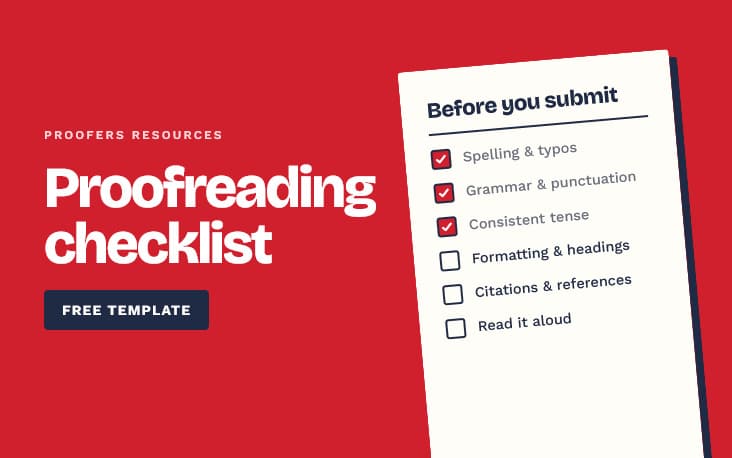
Whether you are submitting a university essay, a business report or a job application, this free proofreading checklist will help you catch the errors that matter most. Most people proofread in a single pass and miss more than they catch — working through each category separately is far more effective.
The checklist covers six key areas: spelling and grammar, punctuation, consistency, formatting, references and a final read-through. Tick off each item before you submit and you will significantly reduce the risk of errors slipping through. Work through each section in a separate pass for the best results — and if you want a professional pair of eyes on your work, our UK-based proofreaders are ready to help.
Why Use a Proofreading Checklist?
Whether you are submitting a university essay, a business report or a job application, this free proofreading checklist will help you catch the errors that matter most. Work through each section in a separate pass for the best results — and if you want a professional pair of eyes on your work, our UK-based proofreaders are ready to help.
Proofreading your own work is notoriously difficult. Your brain tends to read what it expects to see rather than what is actually on the page — which means errors slip through even after multiple reads. A structured checklist solves this by breaking the proofreading process into focused passes, each targeting a specific category of error.
Using a checklist also ensures you do not skip sections under time pressure. Whether you are proofreading an essay, a business report, a dissertation or a cover letter, working through a checklist systematically produces far better results than a single top-to-bottom read.
The checklist below covers every key area you should check before submitting any important document. Work through each section one at a time — do not try to check everything in a single pass.
Spelling and Grammar
Spelling and grammar errors are the most obvious signs of a poorly proofread document. Even a single mistake can undermine the credibility of your work. Use the checklist below to catch the most common issues.
Check
What to Look For
☐ Spellcheck run
Run your word processor’s spellcheck as a baseline — but do not rely on it alone
The team are/is, each of the students was/were — check singular vs plural throughout
☐ Tense consistency
Check that verb tenses do not shift unexpectedly between past and present
☐ Sentence fragments
Every sentence should have a subject and a verb — watch for incomplete clauses
Pro tip: Read the document backwards, sentence by sentence. This forces your brain to focus on individual sentences rather than the flow of ideas — making it much easier to spot errors.
Punctuation
Punctuation errors are surprisingly easy to miss because the eye skips over them. Pay particular attention to commas, apostrophes and quotation marks — these are where most mistakes occur.
Check
What to Look For
☐ Apostrophes
Possessives (the editor’s work) vs contractions (it’s = it is) — never use apostrophes for plurals
☐ Commas
Check for comma splices (two independent clauses joined only by a comma) and missing Oxford commas if your style requires them
☐ Colons and semicolons
A colon introduces; a semicolon links two closely related independent clauses
☐ Quotation marks
Check for consistent use of single or double quotes throughout, and that all opening marks have a closing mark
☐ Hyphens and dashes
Use hyphens for compound adjectives (well-written report), en dashes for ranges (pp. 10–15), em dashes for parenthetical asides
☐ End punctuation
Every sentence should end with a full stop, question mark or exclamation mark — check no sentences are missing their closing punctuation
Consistency
Consistency errors are often the hardest to spot because each instance may look correct in isolation. You need to read for patterns across the whole document — this is where a second pair of eyes really helps.
Check
What to Look For
☐ British vs American spelling
Colour/color, organise/organize, programme/program — pick one and stick to it throughout
☐ Capitalisation
Job titles, proper nouns and headings should be capitalised consistently — decide on a style and apply it throughout
☐ Numbers and figures
Spell out numbers one to nine; use numerals for 10 and above — or follow your style guide. Apply consistently.
☐ Abbreviations and acronyms
Define acronyms on first use (Artificial Intelligence (AI)) and use consistently thereafter
☐ Names and terminology
Check that names, job titles and technical terms are spelled the same way throughout
☐ Heading style
Use sentence case or title case for headings — pick one and apply it consistently to all headings at the same level
Prefer to have a professional do this for you?
Our UK-based proofreaders will check your document against every item on this list — and catch the errors you missed. All orders come with a full money-back guarantee.
Formatting errors can make an otherwise well-written document look unprofessional. Work through this section after you have finished checking the content itself.
Check
What to Look For
☐ Font and size consistency
Check for accidental font or size changes — especially in copy-pasted sections
☐ Paragraph spacing
Look for double spaces between paragraphs or inconsistent line spacing throughout
☐ Double spaces after full stops
Use Find and Replace to remove any double spaces — a common legacy typing habit
☐ Heading hierarchy
H1, H2, H3 should follow a logical structure — do not skip levels or use headings out of order
☐ Page numbers and headers/footers
Check page numbers are sequential and header/footer content is correct throughout
☐ List formatting
Bullet points and numbered lists should use consistent punctuation and capitalisation
References and Citations
For academic and professional documents, reference errors can be particularly damaging. A single incorrect citation can call the credibility of your entire argument into question.
Check
What to Look For
☐ In-text citations present
Every quoted or paraphrased source should have an in-text citation in the correct format for your referencing style
☐ Reference list complete
Every in-text citation should have a corresponding entry in your reference list — and vice versa
☐ Referencing style consistent
Harvard, APA, Vancouver, OSCOLA — pick one and apply it consistently throughout. Do not mix styles.
☐ Author names and dates correct
Check author surnames, initials and publication years are accurate in both in-text citations and reference list entries
☐ URLs and DOIs active
Test all web links to confirm they are still live — dead links are a common oversight in submitted work
☐ Quotation accuracy
Direct quotations should be word-for-word accurate — double-check against the original source
Final Read-Through Tips
Once you have worked through each section of the checklist, do a final top-to-bottom read using one or more of the following techniques to catch anything that remains:
Read aloud. Reading your document aloud forces you to slow down and process every word. Awkward phrasing, missing words and run-on sentences become immediately obvious when spoken.
Change the format. Print your document out or change the font and size before your final read. A different visual presentation tricks your brain into reading more carefully.
Take a break first. If time allows, leave at least a few hours (ideally overnight) between finishing your writing and beginning your proofreading. Fresh eyes catch far more than tired ones.
Use text-to-speech. Most word processors and browsers have a read-aloud function. Hearing your words read back by a neutral voice is an excellent way to catch errors your eye would skip.
Check the beginning and end separately. The opening paragraph and closing sentences are the most important — and the most often overlooked. Give them an extra check.
Important: Even after working through this entire checklist, there is no substitute for a professional proofreader. The human eye is highly susceptible to seeing what it expects to see — a fresh pair of professional eyes will always catch more than you can yourself.
Want us to check it for you?
Send your document to our UK-based proofreaders and we will return it polished, accurate and error-free — with tracked changes so you can see every edit. Most orders returned within 24 hours.
A comprehensive proofreading checklist should cover spelling and grammar, punctuation, consistency (spelling conventions, capitalisation, numbers), formatting, and references or citations. Working through each category in a separate pass is more effective than trying to check everything at once.
How many times should you proofread a document?
Most professional proofreaders recommend at least two to three separate passes through a document — each focused on a different category of error. A single read-through, even a careful one, is rarely sufficient to catch everything. The most important pass is usually a final read-aloud once all corrections have been made.
What is the most common proofreading mistake?
The most common mistake is relying solely on spellcheck. Spellcheck will not catch correctly spelled words used in the wrong context (their/there, affect/effect), missing words, or consistency errors. A spellcheck is a useful starting point — but it is never a substitute for careful manual checking.
Should I proofread on screen or on paper?
Many experienced proofreaders recommend printing the document for at least one pass. The change in format helps your brain process the text more critically, and it is easier to mark up errors with a pen. That said, proofreading on screen is perfectly effective if you use the techniques above — particularly reading aloud and using text-to-speech.
How is proofreading different from editing?
Proofreading focuses on surface-level errors: spelling, grammar, punctuation and consistency. Editing (or copy editing) goes deeper — an editor will also improve the clarity, flow, structure and style of your writing. If your document needs both, our copy editing service covers everything a proofreader does, plus the deeper improvements that make your writing truly shine.
Can I use this checklist for any document type?
Yes — the checklist above applies to essays, dissertations, business reports, CVs, cover letters, web copy and most other document types. For academic work, pay particular attention to the references section. For business documents, the consistency and formatting sections are especially important.
Summary
A proofreading checklist breaks the process into focused passes — spelling and grammar, punctuation, consistency, formatting and references
Do not try to check everything in a single read — work through each category separately
Reading aloud, changing the format and taking a break before proofreading all significantly improve accuracy
Spellcheck is a useful starting point but will not catch all errors — particularly homophones and context errors
For important documents, professional proofreading is always worth the investment
Submit your document today and our UK-based editors will return it polished, accurate and error-free — with a full money-back guarantee.
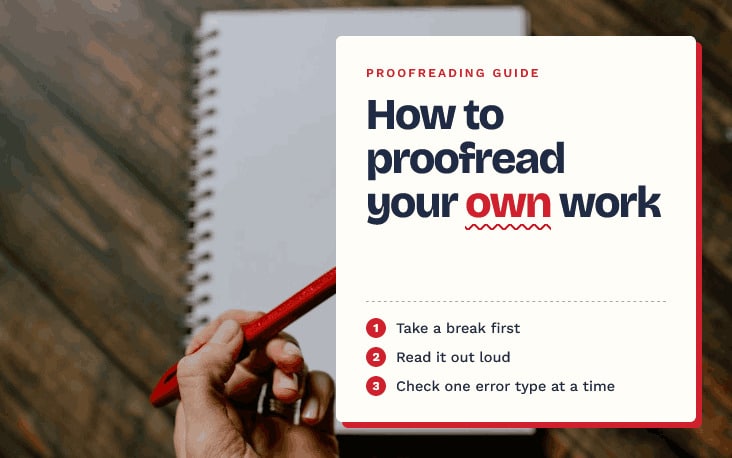
Learn how to proofread your own work effectively with our step-by-step guide. Discover proven techniques, the most common errors to watch for, and when it is worth using a professional proofreader.
Submitting an essay with errors can cost you marks. Our professional essay proofreading service is delivered by UK-based editors, starts from 10 per 1,000 words, with 24-hour turnaround.
Not sure which proofreading service to choose? We compare the best UK proofreading services in 2026 — including price, turnaround time, quality and guarantees — so you can make the right decision.