Posted on 11th November by Proofers Editorial Team
AI tools like ChatGPT can catch spelling errors and suggest rewrites in seconds — but does that make them a genuine replacement for a professional human proofreader? This article examines what AI proofreading tools can and cannot do, where human expertise still has the edge, and how to decide which approach is right for your document.
Whether you are a student submitting a dissertation, a business professional preparing a report, or a writer polishing a manuscript, understanding the real difference between AI and human proofreading could save you from costly errors.
AI tools like ChatGPT, Grammarly, and Hemingway have become genuinely useful for writers. They catch typos, flag awkward sentences, and work at lightning speed. So the question is fair: can AI replace a human proofreader?
The short answer is no — not yet, and not for anything that really matters. But to understand why, it helps to look honestly at what AI tools can and cannot do, and where the gap between them and a skilled human editor actually lies.
What AI Can Do When Proofreading
AI proofreading tools have improved dramatically in recent years. For basic tasks, they perform well:
Spelling and typos — AI reliably catches misspellings, though it can miss correctly-spelled words used incorrectly.
Basic grammar — Subject-verb agreement, missing commas, and sentence fragments are usually flagged.
Passive voice and readability — Tools like Hemingway highlight overly complex sentences.
Consistency checks — Some AI tools spot inconsistent capitalisation or hyphenation.
Speed — An AI tool can scan a 10,000-word document in seconds. No human editor can match that raw speed.
Availability — AI tools are available 24/7. You can run a check at 2am before a deadline without paying rush rates.
For quick, low-stakes writing — a casual email or a first draft you’re not yet attached to — AI tools offer genuine value. They’re fast, cheap, and always available. Used as part of a broader editing process, they can even make a human editor’s job easier by clearing surface clutter before the deeper review begins.
What AI Consistently Misses
This is where the gap between AI and human proofreaders becomes clear. AI tools regularly fail to catch problems that any experienced human editor would spot immediately.
Context and meaning
AI doesn’t truly understand what you’re trying to say. It can miss sentences that are grammatically correct but factually wrong, logically contradictory, or simply unclear to a human reader. A sentence like “The meeting was not unsuccessful” is grammatically fine — but it may be unnecessarily convoluted, and a human proofreader would flag that. AI often does not.
Tone and audience awareness
A human proofreader reads your work with your audience in mind. Is the tone too formal for a student essay? Too casual for a legal document? Too colloquial for a corporate report? AI rarely makes these judgements accurately, because it lacks genuine understanding of human context and social register.
Subject-specific knowledge
Legal, medical, and academic writing has specialised conventions. A human proofreader familiar with your field will spot errors an AI simply doesn’t know to look for. Incorrect use of a legal term, an outdated medical reference, or a citation formatted contrary to your institution’s style guide — these are the kinds of errors that can undermine otherwise strong work.
Structural and flow issues
AI works at the sentence level. It won’t tell you that your argument doesn’t build logically, that the introduction promises something the body doesn’t deliver, or that paragraph three belongs at the end. These structural issues are often what separates competent writing from excellent writing — and they remain firmly in human territory.
Style guide compliance
If your work needs to follow a specific style guide — Oxford, Chicago, Harvard referencing, APA, OSCOLA — a human proofreader applies those rules consistently. AI guesses, and often guesses incorrectly. We regularly see documents where AI has “fixed” referencing into a format that doesn’t match the required style.
What it changes without telling you
Unlike a human proofreader who marks changes clearly, many AI tools silently rewrite text. You may not notice that a nuance has been lost, a technical term replaced, or a carefully chosen word swapped for something blander. When accuracy and voice both matter, invisible edits are a risk.
Human Proofreader vs AI: A Direct Comparison
Task
AI Tool
Human Proofreader
Spelling and typos
✓ Strong
✓ Strong
Grammar
✓ Strong
✓ Strong
Tone and audience
⚠ Limited
✓ Strong
Context and meaning
✗ Weak
✓ Strong
Subject knowledge
✗ Weak
✓ Strong
Structure and flow
✗ Weak
✓ Strong
Style guide compliance
⚠ Limited
✓ Strong
Fact-checking
✗ Cannot do
⚠ Flags concerns
Transparency of changes
✗ Often silent
✓ Tracked changes
Speed
✓ Instant
⚠ Hours/days
Cost
✓ Low/free
⚠ Per-word fee
When to Use AI vs a Human Proofreader
Use AI when:
You’re editing a rough first draft and want quick feedback
The document is low-stakes (internal emails, personal notes)
You want a fast sanity check before sending to a human editor
Budget is a primary constraint and the document doesn’t need to be perfect
Use a human proofreader when:
Your document will be submitted, published, or presented publicly
You’re writing a dissertation, thesis, or academic submission
The work is for a client, employer, or formal purpose
You need consistency with a specific style guide
Your writing includes technical, legal, or subject-specific content
Your reputation or grade depends on the quality of the final document
Many writers use both: AI for a quick first pass to clear obvious errors, then a professional proofreader for the polish that actually matters.
Real-World Scenarios: Which Should You Choose?
It helps to think in concrete terms. Here are scenarios where the choice becomes clear:
University dissertation
A student submitting a 12,000-word dissertation has worked on it for months. The stakes are high. AI tools might catch a few missed commas, but they won’t flag the section where the argument contradicts itself, the paragraph where the referencing style shifts, or the introduction that overpromises. A human proofreader will catch all three. For academic work, the investment in professional proofreading is straightforwardly worth it.
Business proposal
A proposal going to a client or tender panel represents your business. Errors undermine credibility; awkward phrasing loses the reader. An AI tool won’t know that “we can deliver synergistic outcomes” is jargon that alienates decision-makers. A good human editor will cut it.
Blog post or marketing content
For regular content output, a combined approach works well. AI tools handle volume; human editors handle pieces that really matter — a cornerstone article, a case study, or anything that will represent your brand publicly for years.
AI-generated content
If you’re using AI to draft content and want to publish it, AI-generated text has its own distinct problems: repetitive phrasing, generic vocabulary, lack of authentic voice, and the risk of AI detection flags. That’s exactly why our AI content editing service exists — to transform AI drafts into polished, credible writing.
The Cost vs Quality Equation
AI proofreading tools are cheap or free. Professional proofreaders charge per word. For many writers, the cost question is real and reasonable.
But the more useful question is: what is the cost of an error? For a job application, a submitted dissertation, a published article, or a client proposal, a proofreading error can be expensive in ways that have nothing to do with the proofreader’s fee. Lost marks, lost credibility, lost clients — these outcomes cost more than any professional edit.
Professional proofreading at Proofers starts from a few pence per word. For a standard essay or short report, the cost is modest. For a dissertation or long document, it’s a small fraction of the time you’ve invested in the work. See our pricing page for a full breakdown.
The Verdict
AI is a useful tool — but it’s a tool, not a replacement for human expertise. For anything that counts — a dissertation, a business report, a manuscript — the stakes are too high to rely on software alone. Human proofreaders bring understanding, judgement, and accountability that no AI currently matches.
AI has also created a new challenge: AI-generated text that needs to be refined, humanised, and checked for accuracy. That’s exactly why our AI content editing service exists — to bridge the gap between fast AI output and polished, credible writing.
Get a Professional Human Proofreader
Our UK-based editors check everything AI misses — tone, clarity, structure, and style. Fast turnaround, every time.
Is AI proofreading good enough for a university dissertation?
No. Dissertations require precise adherence to academic style guides, logical argumentation, and subject-specific knowledge. AI tools lack the depth to reliably catch all errors. A professional proofreader is strongly recommended for any submitted academic work.
Can ChatGPT proofread my work?
ChatGPT can offer suggestions, but it may rewrite your work rather than simply correct it. For related reading, see: Can ChatGPT proofread your work?
What is the difference between proofreading and copy editing?
Proofreading focuses on surface errors (spelling, grammar, punctuation). Copy editing goes deeper — improving clarity, flow, and structure. Find out more about our copy editing service.
Will AI replace proofreaders in the future?
It’s possible AI will handle more routine checks over time. But nuanced judgement about meaning, context, and audience is a deeply human skill. The most likely future is AI assisting human editors, not replacing them entirely. The demand for high-quality professional editing remains strong precisely because AI output still needs human review.
How much does professional proofreading cost?
Costs vary by document length and turnaround time. At Proofers, we charge per word with rates depending on the service level you need. Our pricing page has full details, and we offer a free sample edit so you can see the quality before you commit.
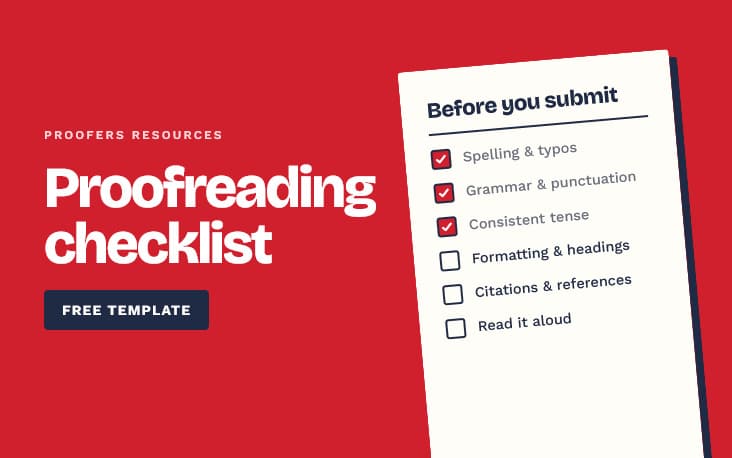
A free, comprehensive proofreading checklist covering spelling, grammar, punctuation, consistency, formatting and references — with practical tips for catching errors before you submit any document.
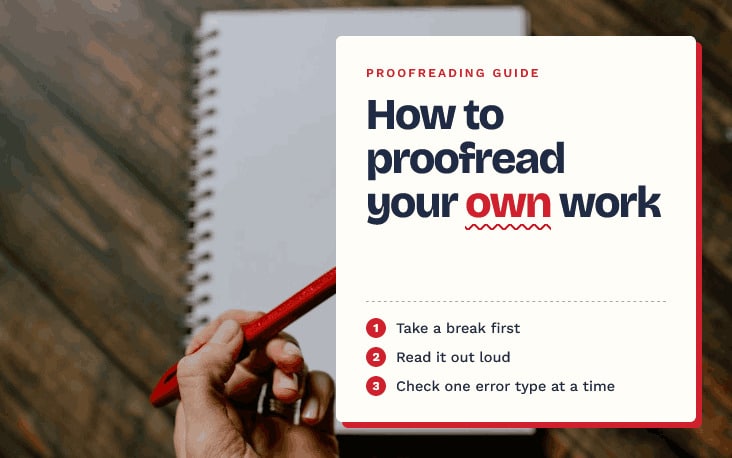
Learn how to proofread your own work effectively with our step-by-step guide. Discover proven techniques, the most common errors to watch for, and when it is worth using a professional proofreader.