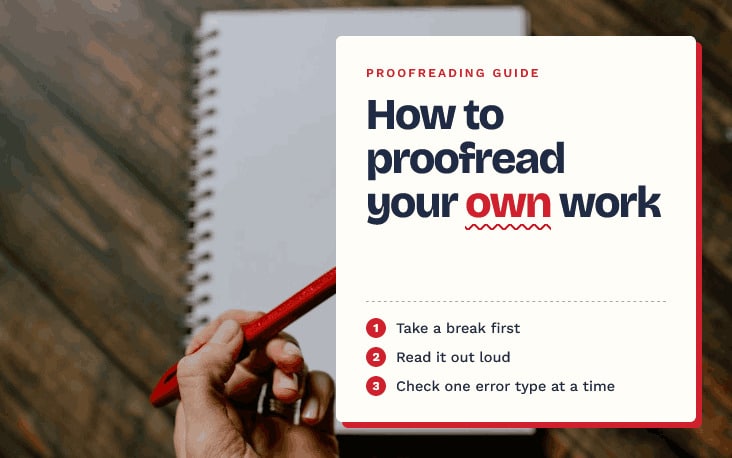
How to Proofread Your Own Work: A Step-by-Step Guide
Posted on 21st October by Admin
Proofreading your own work is one of the most important — and most underestimated — steps in the writing process. Whether you are finishing a university essay, polishing a business report, or finalising a job application, the quality of your proofreading can make the difference between a professional piece of writing and one that lets you down.
The problem is that proofreading your own writing is genuinely difficult. Your brain knows what you meant to say, so it automatically fills in gaps and skips over errors before your eyes even register them. The good news is that there are proven techniques that dramatically reduce how many mistakes you miss — and that is exactly what this guide covers. Follow the steps below and you will catch far more errors than you ever would from a single read-through.
Proofreading your own work is one of the most important — and most underestimated — steps in the writing process. Whether you are finishing a university essay, polishing a business report, or finalising a job application, the quality of your proofreading can make the difference between a professional piece of writing and one that lets you down. This guide walks you through exactly how to do it well.
Want an expert to check your work? Our professional proofreading service catches every error you miss — returned within 24 hours with a full money-back guarantee.
Why Is Proofreading Your Own Work So Difficult?
Proofreading your own writing is genuinely hard — and not because you are a poor editor. The problem is psychological. When you wrote the text, your brain stored what you intended to say. When you re-read it, your brain automatically fills in the gaps and corrects errors before your eyes even register them. Researchers call this proofreading blindness — and it affects everyone, from students to professional writers.
This is why even experienced authors and academics rely on a second pair of eyes before submitting important work. It is not a sign of weakness — it is simply how the human brain works. That said, there are proven techniques that significantly reduce how many errors you miss when checking your own writing.
Before You Start: Preparation Tips
The single most important thing you can do before proofreading is step away from your work. The longer you leave between writing and proofreading, the more your brain forgets what you intended — and the more clearly you will see what is actually there. Even an hour makes a difference; overnight is better.
Here are a few other preparation steps that make a real difference:
Change the format. Paste your text into a different document, change the font, or increase the size. Anything that makes the text look unfamiliar forces your brain to read it more carefully.
Print it out. Reading on paper is fundamentally different from reading on a screen. Many people catch far more errors on a printed copy.
Read in a quiet environment. Distractions cause your brain to skim, which means errors slip through. Find somewhere quiet with no interruptions.
Have a checklist ready. Know in advance what types of errors you are looking for rather than trying to spot everything at once.
How to Proofread Your Own Work: Step by Step
The most effective approach is to proofread in multiple focused passes rather than trying to catch every type of error in a single read-through. Here is the process used by professional editors:
Pass 1: Read for meaning and logic
Do not look for errors yet. Read the whole document and ask: does this make sense? Does each paragraph follow logically from the last? Are there any sentences that are confusing, unclear or contradictory? Fix any structural or logic issues before you focus on the surface errors — otherwise you may spend time correcting sentences that you end up deleting anyway.
Pass 2: Check grammar and sentence structure
Read each sentence in isolation. Does each one have a clear subject and verb? Are there any run-on sentences or fragments? Are your tenses consistent throughout? Pay particular attention to sentences that are very long — these are the ones most likely to contain errors or become confusing.
Pass 3: Check spelling and punctuation
Do not rely on your spell checker for this pass. Spell checkers miss correctly spelled words used in the wrong context (for example, their instead of there). Read each word individually and slowly. One effective technique is to read the text backwards, word by word — this forces you to look at each word in isolation rather than reading for meaning.
Pass 4: Check consistency
Look specifically for inconsistencies throughout the document. This includes: capitalisation (does your document consistently capitalise job titles, for example?), hyphenation (is it email or e-mail throughout?), spelling variants (British vs American English), and formatting (are all your headings the same style?).
Pass 5: Read it aloud
Reading your work aloud is one of the most powerful proofreading techniques available — and one of the most underused. Your voice will stumble at errors your eyes skip over. If you find yourself rephrasing as you read aloud, that is a sign the sentence needs editing. Read slowly and clearly, and pause at every punctuation mark to check it is correct.
Want an expert to check your work? Our professional proofreading service catches every error you miss — returned within 24 hours with a full money-back guarantee.
The Most Common Errors to Look For
Certain errors appear in almost every piece of writing. Knowing what to look for helps you spot them faster.
Error Type
Examples
Homophones
their/there/they’re, affect/effect, your/you’re
Missing words
“The results showed the hypothesis was” (missing “supported”)
Doubled words
“the the”, “and and” — easy to miss when reading for meaning
Apostrophe errors
it’s vs its, your vs you’re, who’s vs whose
Comma splices
Joining two independent clauses with a comma rather than a full stop or semicolon
Inconsistent spelling
Mixing British and American spellings (e.g. colour and color in the same document)
Formatting inconsistencies
Headings in different styles, inconsistent bullet point punctuation
Useful Tools to Help You Proofread
Several tools can assist with proofreading — though none should replace a careful manual check:
Microsoft Word spell check: Useful for obvious spelling errors but misses homophones and context-dependent mistakes.
Grammarly: Catches more errors than a basic spell checker, including some grammar issues. Free version is limited; the paid version is more thorough.
Hemingway Editor: Highlights overly complex sentences and passive voice. Useful for readability, not a substitute for proofreading.
Read Aloud (Microsoft Word): The built-in text-to-speech feature reads your document aloud, which helps you hear errors you might miss visually.
ProWritingAid: A comprehensive editing tool that checks grammar, style, readability and consistency. Popular with academic writers.
These tools are helpful aids but they do not catch everything. For high-stakes documents — dissertations, business proposals, journal submissions — a professional proofreader remains the gold standard.
When to Use a Professional Proofreader
Self-proofreading is a valuable skill, but there are situations where professional proofreading is clearly worth the investment:
Dissertations and theses: The stakes are high and you are too close to the material to spot all your own errors reliably.
Business proposals and pitches: First impressions matter. A single error in a proposal can undermine your credibility.
Academic journal submissions: Papers with language errors are frequently rejected before peer review begins.
Any document where errors would be embarrassing or costly: CVs, cover letters, grant applications, legal documents.
At Proofers, our UK-based editors return your document within 24 hours with a full money-back guarantee. You receive both a tracked changes copy (so you can see every edit) and a clean final copy ready to submit.
Ready for a professional proofreader to check your work?
Our UK-based editors catch every spelling error, grammar mistake and inconsistency — returned within 24 hours with a full money-back guarantee.
As a rough guide, allow around 30 minutes per 1,000 words for a careful proofread. A 10,000-word dissertation would therefore take approximately 5 hours to proofread properly — which is why most students spread this across multiple sessions rather than doing it all in one go.
How many times should you proofread your work?
At a minimum, three times — but each pass should focus on something different (structure, grammar, spelling). Many professional writers proofread five or more times before considering a document finished. There is no upper limit — but after a certain point, a fresh set of eyes from a professional proofreader will catch things you simply cannot see yourself.
Does spell check replace proofreading?
No. Spell checkers catch obvious typos but miss correctly spelled words used incorrectly (homophones, for example), grammar errors, missing words, doubled words, and punctuation mistakes. They are a useful first step — not a substitute for careful proofreading.
What is the difference between proofreading and editing?
Proofreading focuses on surface-level errors: spelling, grammar, punctuation and consistency. Editing — specifically copy editing — goes deeper, improving the clarity, flow and structure of your writing as well. For important documents, many writers benefit from both: editing first, then proofreading as the final check before submission.
Should I proofread on screen or on paper?
Both, if possible. Reading on paper forces you to engage with the text differently and many people catch more errors on a printed copy. However, if printing is not practical, enlarging the font size and using a different colour scheme can produce a similar effect.
Submitting an essay with errors can cost you marks. Our professional essay proofreading service is delivered by UK-based editors, starts from 10 per 1,000 words, with 24-hour turnaround.
Not sure which proofreading service to choose? We compare the best UK proofreading services in 2026 — including price, turnaround time, quality and guarantees — so you can make the right decision.
Find out exactly what happens when you use a dissertation proofreading service — what editors check, how long it takes, and how to get the most from the process.